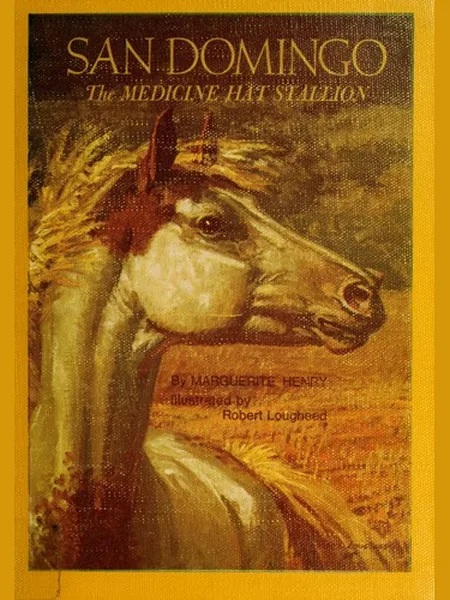
San Domingo
- Editions tracked
- 2
- First edition
- Rand McNally, 1972
The first edition of San Domingo by Marguerite Henry was published in Chicago by Rand McNally in 1972. We track 2 editions.
Which edition do you have?
First edition
Later and other editions
We have not yet researched the issue points for this book. If you know how to tell the first from later printings, tell us and we will credit you once it is checked against a second source.
Awards, adaptations and setting
In print
- Editions recorded
- 16 on Open Library, 13 in English
From Wikidata and Open Library, both CC0. A prize or a new adaptation often lifts demand for the first printing.
More by Marguerite Henry
- Sea Star, Orphan of Chincoteague1920 · 2 editions
- Justin Morgan Had a Horse1945 · 1 edition
- Benjamin West and His Cat Grimalkin1947 · 1 edition
- Misty of Chincoteague1947 · 2 editions
- King of the Wind1948 · 2 editions
- Brighty of the Grand Canyon1953 · 2 editions
- Stormy, Misty's Foal1963 · 2 editions
- White Stallion of Lipizza1964 · 2 editions
Questions about San Domingo
Reviews of San Domingo
Read it or own it? Share what San Domingo is like to read or collect.
Know what you are looking at
How to Identify a First Edition
To identify a first edition, check that your copy is the first printing of the first edition. Read the copyright …
Read the guide →6 min readBook Condition Grading: Fine to Poor Explained
Book condition grading uses a six-step trade scale: Fine, Near Fine, Very Good, Good, Fair and Poor. Collectors grade the …
Read the guide →7 min readDust Jackets Explained: Why the Jacket Drives a Book's Value
For most books published since the 1920s, the original dust jacket carries a large share of the value, often most …
Read the guide →Frequently asked questions
Who published the first edition of San Domingo?
The first edition of San Domingo by Marguerite Henry was published in Chicago by Rand McNally in 1972.
How many editions of San Domingo are there?
We track 2 editions of San Domingo, including 1 first edition. Each has its own page with how to identify it.