The first edition of The Tale of Peter Rabbit is the one Beatrix Potter paid to print herself: 250 copies, ready on 16 December 1901, with a colour frontispiece, black and white line drawings and a flat spine. Frederick Warne's first trade edition, in full colour, followed in October 1902. Both are collected, and so are Warne's other early "little books", but most copies found today are later printings that are worth far less. This guide shows how to tell them apart.
The standard references are Leslie Linder's A History of the Writings of Beatrix Potter (Warne, 1971) and Jane Quinby's check list. Dealers cite both: "Quinby 1, Linder p.420" means the 1901 Peter Rabbit.
Peter Rabbit: three first editions
ILAB describes Peter Rabbit as a book with three first editions. Each is a different object.
1. The privately printed first issue (December 1901)
Potter had 250 copies printed and sold them herself at 1s 2d. They sold out in about two weeks. Look for:
- small paper boards with a flat spine and a black line picture and lettering on the front
- a colour frontispiece and 41 black and white drawings
- pictures Warne later cut (it dropped eleven), such as a rabbit smoking a pipe
Sources describe the board colour as grey, grey-green or fawn, so do not rely on colour alone. The V&A holds Potter's own working copy in pale grey boards. See the 1901 edition page.
2. The privately printed second issue (February 1902)
A further 200 copies followed in February 1902, with small changes to the text, the date added to the title page and a rounded spine. Collectors call the two issues the flat-backed and round-backed rabbits. The 1902 issue is usually described in olive green boards.
3. Warne's first trade edition (October 1902)
Frederick Warne's edition has 31 colour pictures from Potter's watercolours. The first printing ran to 8,000 copies, and two more followed before Christmas (12,000 in November and 8,220 in December). The three printings are the same inside, so a first printing is identified by details that changed later:
- Page 51 reads "wept big tears". Later printings read "shed big tears".
- Plain endpapers in a pale grey leaf pattern. Pictorial endpapers arrived in 1903.
- An undated title page and 97 pages. Fitting the pictorial endpapers cut the book to 85 pages and four colour plates.
- Bindings: brown or grey paper boards at 1s, or a deluxe pale green cloth at 1s 6d. Some second and third printings were bound in green boards.
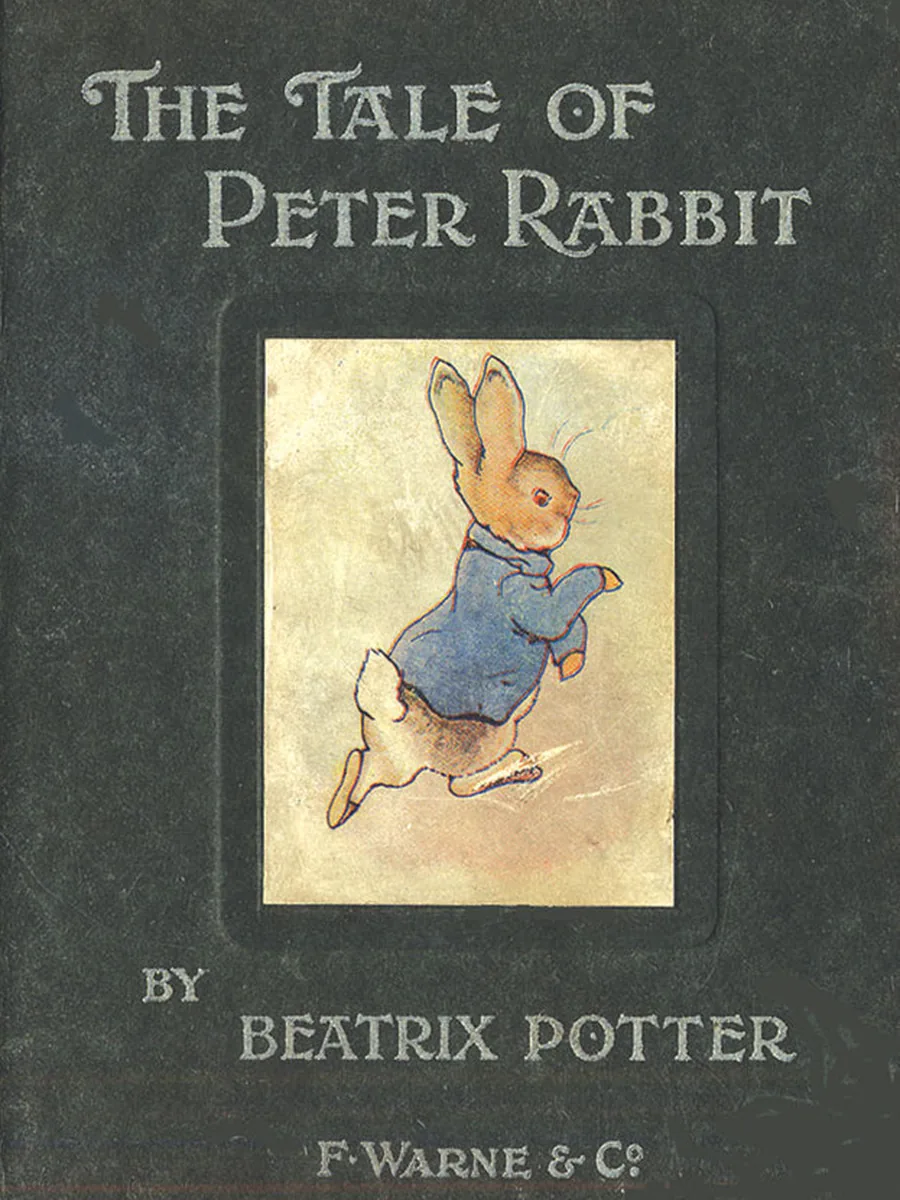

The book came in a thin glassine wrapper printed with the price on the spine. Jonkers calls a first printing in its original wrapper extremely unlikely, though at least one is known.
The other early little books
| Year | Title | First edition | Points |
|---|---|---|---|
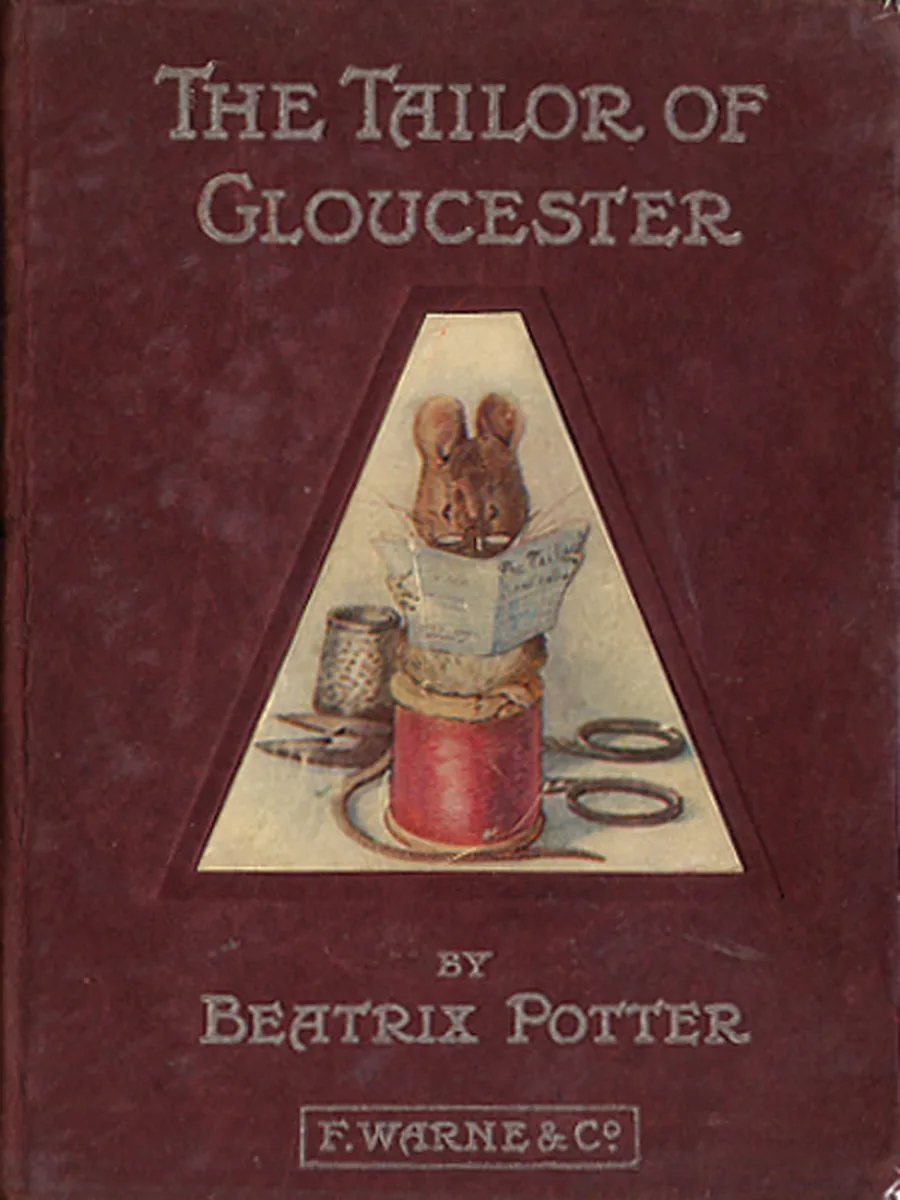
| 1902 | The Tailor of Gloucester | Privately printed, December 1902, 500 copies | Pink pictorial boards; 16 colour plates, three not in the trade edition |
| 1903 | The Tale of Squirrel Nutkin | Warne, August 1903 | Grey or dark blue boards; a deluxe issue in flowered chintz |
| 1904 | The Tale of Benjamin Bunny | Warne, 1904 | "muffatees" misspelt on page 15 |
| 1908 | The Tale of Jemima Puddle-Duck | Warne, 1908 | Dated 1908 on the title page of the first three printings |

A few cautions:
- The Tailor of Gloucester. Warne's trade edition of October 1903 is not the first. Potter's private printing came first, with eight or nine more pages of text, mostly rhymes.
- Squirrel Nutkin. It was reprinted the month after publication, and Bauman says the two cannot be told apart, although some catalogues still describe a "first issue". The deluxe issue is bound in a floral cotton printed by Edmund Potter & Co., her grandfather's Manchester calico firm.
- Benjamin Bunny. The "muffatees" misprint is also in the first American edition, published by Warne's New York office, so check the imprint as well as the misprint.
- Jemima Puddle-Duck. The first three printings all carry the date and are believed to be identical, so a dated 1908 copy may be any of them.
Dating a later Warne printing
Most Potter books you find will be later printings. Warne's own system is hard to read, but three clues help:
- The imprint. "F. Warne & Co." without "Ltd" is before 1919, when the firm became a limited company.
- The endpapers. From 1903 Warne used a chain of characters on the endpapers and added new ones as books appeared. Dealers and auction houses identify these by Linder's design numbers, and the characters shown give a date after which the copy was printed.
- The style. An undated Peter Rabbit with decorated endpapers but the 1902 cover style dates from 1918 or later, according to the University of Iowa's special collections.
American editions
Warne never secured American copyright for Peter Rabbit, so the book was in the public domain in the United States. Henry Altemus of Philadelphia issued an unauthorised edition in 1904, and many others followed. These are collected for their own sake but are not first editions. Warne's own New York office issued authorised American editions of later titles, such as Benjamin Bunny, often without a date.
What they sell for
- 1901 first issue: £20,000 at a London sale of the Ottignon collection in 2013. Recent estimates for fine copies run from £25,000 to £60,000.
- 1902 second private issue: £12,000 at the same sale.
- Warne first edition: a specially bound copy inscribed by Potter in 1919 made $94,400 at Profiles in History in 2009. Jonkers notes that a fine Warne first in its wrapper reaches five figures, while a worn later copy can be a couple of hundred pounds.
Prices come from named sales, not valuations of your book. Our guide to how much your book is worth explains how to compare like with like.
Check your copy
- Look at the spine and the pictures. A flat spine with black and white drawings may be the 1901 private issue.
- Check the title page for a date and the imprint for "Ltd".
- Look at the endpapers: plain leaf pattern or pictorial characters.
- On a Warne Peter Rabbit, read page 51: "wept" or "shed" big tears.
- Count the colour plates and compare the page count.
- Grade the boards, which rub easily, using our condition guide, and try Is my book valuable?.
Frequently asked questions
How do I know if my Peter Rabbit is a first edition?
The true first is the privately printed book of December 1901, with a flat spine and black and white pictures. For the Warne edition, a first printing of October 1902 is undated, has plain leaf-pattern endpapers and reads 'wept big tears' on page 51; later printings read 'shed big tears'.
How many first edition Peter Rabbits were printed?
Potter had 250 copies printed privately in December 1901 and 200 more in February 1902. Frederick Warne's first trade printing of October 1902 ran to 8,000 copies, followed by 12,000 in November and 8,220 in December.
How much is a first edition Peter Rabbit worth?
A 1901 private first issue made £20,000 at a London sale in 2013, and the 1902 private second issue £12,000. A specially bound, inscribed Warne first made $94,400 in 2009, while a worn later Warne copy can be worth only a couple of hundred pounds.
What do the endpapers tell you about a Beatrix Potter book?
Warne's pictorial endpapers show a chain of Potter's characters, and new characters were added as new books appeared. Matching the characters to Leslie Linder's numbered endpaper designs helps date a printing; the very first Peter Rabbits have plain leaf-pattern endpapers.
Does F. Warne & Co. Ltd mean a later printing?
Yes. Frederick Warne became a limited company in 1919, so an imprint reading 'F. Warne & Co. Ltd' dates a copy to 1919 or later. Earlier printings read 'F. Warne & Co.' without 'Ltd'.
Where these facts come from
- Show me the bunny: Beatrix Potter and Peter Rabbit, the three first editions, ILAB (ilab.org)
- The Tale of Peter Rabbit, privately printed, Jonkers Rare Books (jonkers.co.uk)
- The Tale of Peter Rabbit (collecting guide), Jonkers Rare Books blog (jonkers.co.uk)
- First edition of The Tale of Peter Rabbit, University of Iowa Special Collections, 2014 (blog.lib.uiowa.edu)
- The Tale of Peter Rabbit, Beatrix Potter's working copy, Victoria and Albert Museum (collections.vam.ac.uk)
- The Tale of Peter Rabbit, 1901, Christie's (christies.com.cn)
- 150 years of Beatrix Potter, State Library Victoria (blogs.slv.vic.gov.au)
- The Tailor of Gloucester, privately printed, Bauman Rare Books (baumanrarebooks.com)
- The Tailor of Gloucester, Wikipedia (en.wikipedia.org)
- The Tale of Squirrel Nutkin, Christie's (christies.com.cn)
- The Tale of Squirrel Nutkin, Bauman Rare Books (baumanrarebooks.com)
- The Tale of Squirrel Nutkin, deluxe issue, Jonkers Rare Books (jonkers.co.uk)
- The Tale of Benjamin Bunny, Jonkers Rare Books (jonkers.co.uk)
- 1904 first US edition, The Tale of Benjamin Bunny, Libra (mflibra.com)
- The Tale of Jemima Puddle-Duck, Bauman Rare Books (baumanrarebooks.com)
- Peter Rabbit first edition tops Ottignon collection, Paul Fraser Collectibles, 2013 (paulfrasercollectibles.com)
- Tale of Peter Rabbit scampers to $94k, Paul Fraser Collectibles, 2009 (paulfrasercollectibles.com)
- A History of the Writings of Beatrix Potter, Leslie Linder, 1971 (catalogue record), Toronto Metropolitan University (childrenslit.library.torontomu.ca)
Points of issue are listed only where at least two independent sources agree. Last reviewed 18 October 2026.
Last reviewed 18 October 2026.