A Hobbit first edition, first impression is the George Allen & Unwin book published in London on 21 September 1937. Only 1,500 copies were printed, all with Tolkien's black and white pictures and no colour plates. The Lord of the Rings followed in three volumes in 1954 and 1955, in first impressions of 3,000, 3,250 and 7,000 copies. Both are among the most valuable twentieth century books, and both have later printings that look like firsts at a glance.
Collectors and auction houses describe these books with the numbers in Wayne G. Hammond and Douglas A. Anderson's J.R.R. Tolkien: A Descriptive Bibliography (1993): A3a for the British Hobbit, A5a for The Lord of the Rings. A seller who quotes Hammond is telling you which state they think a copy is.
The Hobbit (1937)
The first impression
The Hobbit was printed by Unwin Brothers in May 1937 and sold out by Christmas. According to tolkienbooks.net, whose figures broadly follow Hammond, 1,488 copies were bound for the trade, with about 28 travellers' samples and a few paper-covered copies, probably for reviewers.
Look for:
- light green cloth stamped in dark blue
- a top edge stained green
- endpapers printed with Thror's map and the map of Wilderland, in red and black
- black and white illustrations only, with no colour plates
Sources count the illustrations differently (Wikipedia says ten plus the maps, while one Christie's lot lists a frontispiece, eight pictures in the text and one inserted plate), so check by the absence of colour rather than by a count.
The jacket
Tolkien designed the jacket himself. To keep costs down the publisher printed it in black, blue and green only, dropping the red Tolkien wanted for the sun. On the first-state jacket the name Dodgson on the rear flap is misprinted "Dodgeson", with the extra e struck out by hand. A first impression in this jacket sold for $68,750 at Christie's New York in 2021, against an estimate of $20,000 to $40,000, even with some restoration.
The second impression: the colour plates
The second impression is dated 1937 on the title page but was issued in January 1938. It added Tolkien's colour plates, which were made for the American edition. Bonhams describes four. The London book left out the eagle picture that the American one includes. About 2,300 copies were printed, and 423 unbound sets were destroyed in the Blitz in 1940.
So a 1937 Hobbit with colour plates is a second impression. It is still a first edition and a valuable book: Bonhams sold one in its jacket for £3,187.50 in 2019, and one without a jacket for £1,875 in 2018. A true first impression sells for many times that.
The third impression (1942) ran to 4,500 copies, of which 3,000 sets of sheets went to Foyles for its Children's Book Club, and the fourth (1946) to 4,000.
The American first (1938)
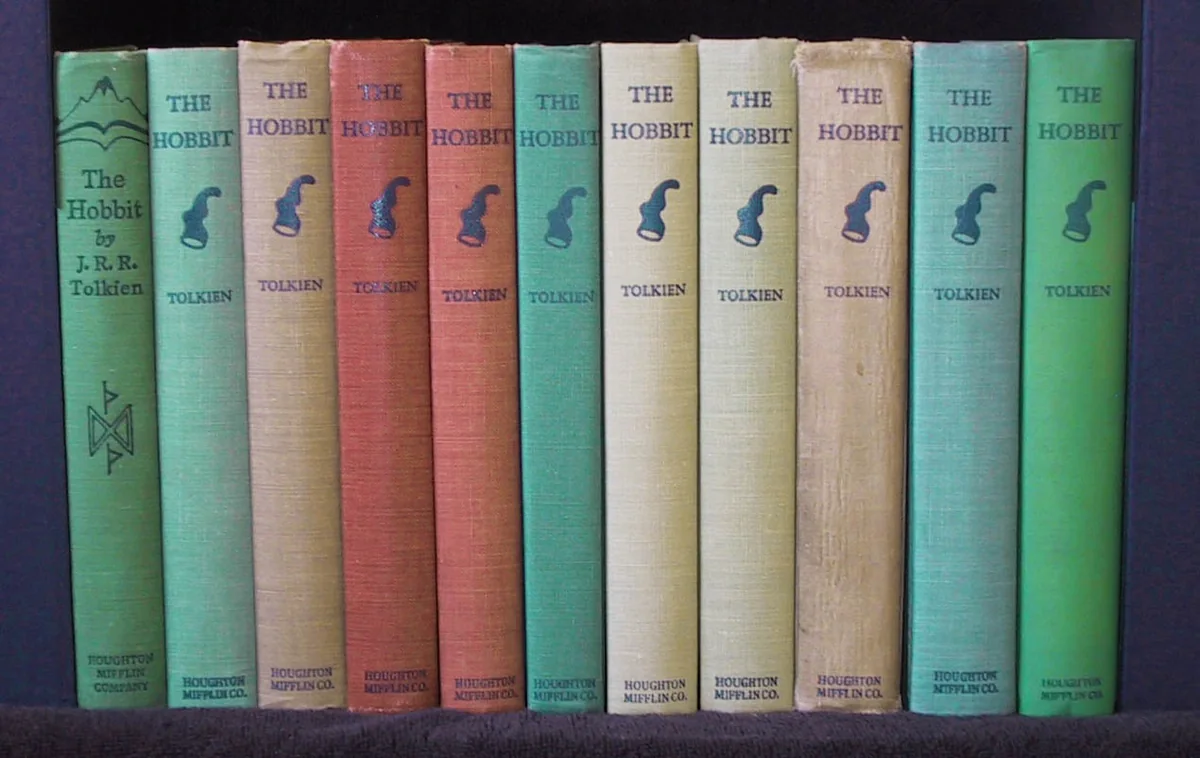
Houghton Mifflin's edition of 1 March 1938 is the first American edition. Bauman puts the run at 5,000 copies. The first printing has:
- a bowing hobbit on the title page (later printings show a seated flute player)
- chapter VII misnumbered VI on page 118
- no half-title
- 312 pages, against 310 in later printings

The Lord of the Rings (1954 to 1955)
Allen & Unwin split the book into three volumes to limit its risk, and Tolkien took no advance. The first impressions:
| Volume | Published | First impression |
|---|---|---|
| The Fellowship of the Ring | 29 July 1954 | 3,000 copies |
| The Two Towers | 11 November 1954 | 3,250 copies |
| The Return of the King | 20 October 1955 | 7,000 copies |
Each is bound in red cloth with gilt titles on the spine and has a folding map in red and black at the back, drawn by Christopher Tolkien. The jackets are grey, printed in red and black.
Points to check
- The Fellowship of the Ring. For the second impression (December 1954) the printers reset the type without telling the publisher, which introduced errors that stayed in print for decades. Comparing your text with a known first impression is the surest test; ask the seller to confirm the impression.
- The Return of the King, page 49. Copies differ in whether the type on this page is damaged and whether a signature mark "4" appears at the foot. Hammond first ranked the copies with the mark as earliest, then reversed his view in The Tolkien Collector, so dealers' catalogues disagree on which is the first state. Expect a description of the page 49 state, not a verdict.
- The Return of the King jacket. The rear flap exists plain, listing the three titles, and with review quotes added. tolkienbooks.net records the plain version as the earlier printing.
Sets in the original jackets are scarce, and prices for the best copies have climbed fast. Bonhams sold a first impression set in worn jackets for £5,687.50 in 2019. In 2025 Heritage sold an unsigned set in jackets for $250,000, and Forum Auctions sold a set signed by Tolkien and presented to Allen & Unwin's sales manager for £287,700, reported as a record for a Tolkien book.
The first American edition (Houghton Mifflin, 1954 to 1956) was bound at first from British sheets; its first impression of Fellowship ran to 1,500 copies.
Other Tolkien firsts
- Farmer Giles of Ham (Allen & Unwin, 20 October 1949). Pauline Baynes's pictures, orange boards stamped in blue, a jacket priced 6s net.
- The Adventures of Tom Bombadil (Allen & Unwin, 1962). Also illustrated by Pauline Baynes; the first impression ran to 10,600 copies, and a second followed the same year.
- The Silmarillion (Allen & Unwin, 15 September 1977), edited by Christopher Tolkien. Two first printings exist: an export issue with an unpriced jacket and a home issue with the jacket priced £4.95. Both say "First published in 1977", and dealers disagree on which came first.
What drives value
- Impression first. For The Hobbit the gap between the first and second impressions is enormous. For The Lord of the Rings, every volume should be a first impression for a set to be called a first edition set.
- The jacket. A first-state Hobbit jacket, or original jackets on all three LOTR volumes, multiplies the value.
- Association and signatures. Copies inscribed by Tolkien, or with a link to his circle, set the records.
- Condition. These books were read and lent. See book condition grading.

Check your copy
- Open the title page and its back. Note the publisher, the date and any impression statement.
- For a 1937 Hobbit, look for colour plates. None means a possible first impression; colour plates mean the second.
- Check the binding and endpapers against the points above.
- On a Hobbit jacket, look at the rear flap for the corrected "Dodgeson".
- For The Lord of the Rings, check every volume's impression, and the page 49 state in The Return of the King.
- Find your copy on its MyVolumes edition page, or use Is my book valuable?. For anything that looks like a first impression, ask a specialist dealer or auction house to examine it.
Frequently asked questions
How do I know if my Hobbit is a first edition?
A first impression is the George Allen & Unwin edition of 1937 with only black and white illustrations, in light green cloth with a green-stained top edge and map endpapers. A copy dated 1937 that has colour plates is the second impression, issued in January 1938.
How many first editions of The Hobbit were printed?
1,500 copies of the first impression were printed in 1937, and the edition sold out by December. Most bound copies went to the trade; a handful were travellers' samples or paper-covered review copies.
How much is a first edition Hobbit worth?
A first impression in a first-state jacket sold for $68,750 at Christie's New York in 2021, and an inscribed copy made £137,000 at Sotheby's in 2015. A second impression without a jacket made £1,875 at Bonhams in 2018.
What is the Dodgeson error on the Hobbit jacket?
On the first-state jacket of the 1937 Hobbit, the name Dodgson on the rear flap is misprinted Dodgeson, and the extra e was struck out by hand. Christie's treats the corrected misprint as the sign of the first-state jacket.
How many first editions of The Lord of the Rings were printed?
The first impressions were 3,000 copies of The Fellowship of the Ring (1954), 3,250 of The Two Towers (1954) and 7,000 of The Return of the King (1955), all from George Allen & Unwin.
Where these facts come from
- The Hobbit, Wikipedia (en.wikipedia.org)
- Early Hobbits, tolkienbooks.net (tolkienbooks.net)
- The Hobbit, first edition, first impression, Christie's (christies.com.cn)
- The Hobbit, first impression in first-state jacket, Christie's New York, lot 385, 2021 (as recorded by veryimportantlot.com) (veryimportantlot.com)
- The Hobbit, first edition, second impression, Bonhams, 2018 (bonhams.com)
- The Hobbit, second impression in jacket, and The Lord of the Rings first impressions, Bonhams, 2019 (bonhams.com)
- The Hobbit, first American edition, Bauman Rare Books, 2023 (baumanrarebooks.com)
- The Hobbit, Houghton Mifflin 1938, tolkienbooks.us (tolkienbooks.us)
- The Lord of the Rings, Wikipedia (en.wikipedia.org)
- The Lord of the Rings, first editions, Jonkers Rare Books (jonkers.co.uk)
- The Fellowship of the Ring, second impression, Tolkien Library (tolkienlibrary.com)
- The Return of the King, first impression, tolkienbooks.net (tolkienbooks.net)
- The Lord of the Rings, English Literature sale, lot 624, Sotheby's, 2018 (sothebys.com)
- New world record set for Tolkien's Lord of the Rings, Fine Books Magazine, 2025 (finebooksmagazine.com)
- Tolkien's Lord of the Rings sold for record $250,000, Fine Books Magazine, 2025 (finebooksmagazine.com)
- The Hobbit sets new auction record, Paul Fraser Collectibles, 2015 (paulfrasercollectibles.com)
- J. R. R. Tolkien: A Descriptive Bibliography, Wikipedia (en.wikipedia.org)
- The Silmarillion, true first, Thompson Rare Books (AbeBooks listing) (abebooks.com)
Points of issue are listed only where at least two independent sources agree. Last reviewed 18 October 2026.
Last reviewed 18 October 2026.