Most people asking whether they own a Harry Potter first edition have a copy of Philosopher's Stone, and most copies are later printings. A true first is a 1997 Bloomsbury first printing, in hardback or paperback, and you can usually settle the question in under a minute by reading the copyright page. This guide covers the checks for all seven books, the traps that catch sellers out and what real copies have fetched at auction.

The one-minute check for Philosopher's Stone
Open the book at the copyright page, on the back of the title page. A first printing of Harry Potter and the Philosopher's Stone has:
- A full number line:
10 9 8 7 6 5 4 3 2 1. If the lowest number is 2 or higher, the copy is a later printing. Our guide to number lines explains why. - Only one date: 1997. A later year anywhere on the page means a reprint.
- Bloomsbury named at the foot of the title page.
If all three are right, move on to the issue points below. If any one fails, you have a later printing, which is still a lovely book but worth tens of pounds rather than thousands.
Issue points that support a 1997 first
These details back up the copyright page. None of them is proof on its own, because each also turns up in some later printings.
- '1 wand' twice on page 53. Harry's list of school equipment repeats the wand. The slip survived into later printings, which is why it confirms rather than proves.
- 'Philospher's' on the rear cover. The title is misspelt, with the second o missing, on the back of the paperback.
- Joanne Rowling in the copyright line. Early printings credit the text to Joanne Rowling rather than J.K. Rowling. Auction houses note that this is shared by all early printings, so treat it as a sign of an early copy, not of the first.
Read more about how collectors use details like these in points of issue explained.
Hardback or paperback: both count
Bloomsbury published the book in June 1997 in two formats at once, and dealers give neither priority. Sotheby's gives the first printing as 500 hardbacks and 5,150 paperbacks, a figure Jonkers Rare Books repeats.
| First hardback | First paperback | |
|---|---|---|
| Copies printed | 500 | 5,150 |
| Where they went | About 300 to libraries | Bookshops |
| Binding | Pictorial boards, no dust jacket | Pictorial card covers |
| Our edition page | 1997 hardback | 1997 paperback |
The hardback was issued without a dust jacket, with Thomas Taylor's art printed on the boards. A first-printing hardback offered in a jacket has had one added, or is a later printing.
Because most hardbacks went to libraries, many survivors carry stamps, labels, pockets or the marks of a removed plastic sleeve. That is normal for this printing and does not make a copy a fake, though it lowers the value. See our guide to book condition grading for how the trade describes such faults.
The later books: what a first looks like
The next two books follow the same pattern as the first. From Goblet of Fire onwards, Bloomsbury printed vast first runs, so a first edition is easy to find.
- Chamber of Secrets (1998). A full number line ending in 1, dated 1998, with Bloomsbury as publisher. The hardback came in a pictorial jacket by Cliff Wright, and the jacket matters a great deal to value.
- Prisoner of Azkaban (1999). The first impression exists in two states. The first state credits Joanne Rowling on the copyright page and has a broken passage on page 7, where a block of text about Wendelin the Weird is misplaced. The second state corrects both.
- Goblet of Fire (2000). The words First Edition appear on the copyright page below the printer credits.
- Order of the Phoenix (2003). The copyright page says First published in Great Britain in 2003 and First edition.
- Half-Blood Prince (2005). Published on 16 July 2005. Check for a first edition statement and that the ISBN is the standard children's edition.
- Deathly Hallows (2007). Published on 21 July 2007. The same checks apply: a first edition statement and the children's edition ISBN.
For the last four books, an unremarkable first edition is worth little more than a good reading copy. What lifts one is a fine, unfaded jacket, a crisp book and, above all, a signature with sound provenance.
Common misconceptions
"It says First published in 1997, so it is a first edition." Every printing of Philosopher's Stone carries that line. It tells you when the book first appeared, not which printing you hold. Only the number line settles it.
"The ISBN matches, so it is the first." Bloomsbury used the paperback's ISBN for reprints for years, so the number alone proves nothing.
"Deluxe and special editions are rarer, so they are firsts." Bloomsbury published deluxe, adult-cover and special editions alongside the standard books. They have their own ISBNs and their own first printings, and they are valued separately from the children's first edition.
"An American copy is the true first." Scholastic's Harry Potter and the Sorcerer's Stone appeared in 1998, after the British book. Its copyright page reads First American edition, October 1998. It had a far larger print run and, while fine copies are collected, it is a different and much cheaper book. US book club printings also exist and can look similar to the trade edition; our book club editions guide covers the general tells.
"A jacket from a first means the book is a first." Jackets get swapped between copies. The book's own copyright page decides the printing, and a later jacket on a first-printing book is a fault the trade calls a married jacket. Our guide to dust jackets explains what to look for.
Signed copies and provenance
A signature can multiply the value of a later first edition, which is exactly why Harry Potter signatures are among the most forged in modern book collecting. Treat any signed copy offered without a clear history with caution.
- Ask where it came from. A dated inscription at a known signing, a photograph of the signing or a receipt from the shop that hosted it all help.
- Prefer established sellers. Reputable dealers and auction houses check signatures and will stand behind what they sell.
- Value the book first. A signature on a later printing does not turn it into a first printing, and a signed first is still graded on its own condition.
Our guide to signed and inscribed books covers the different kinds of signature and how the trade describes them.
What first editions have fetched at auction
Prices for the 1997 hardback depend heavily on condition, and the gap between a worn library copy and a fine one is enormous.
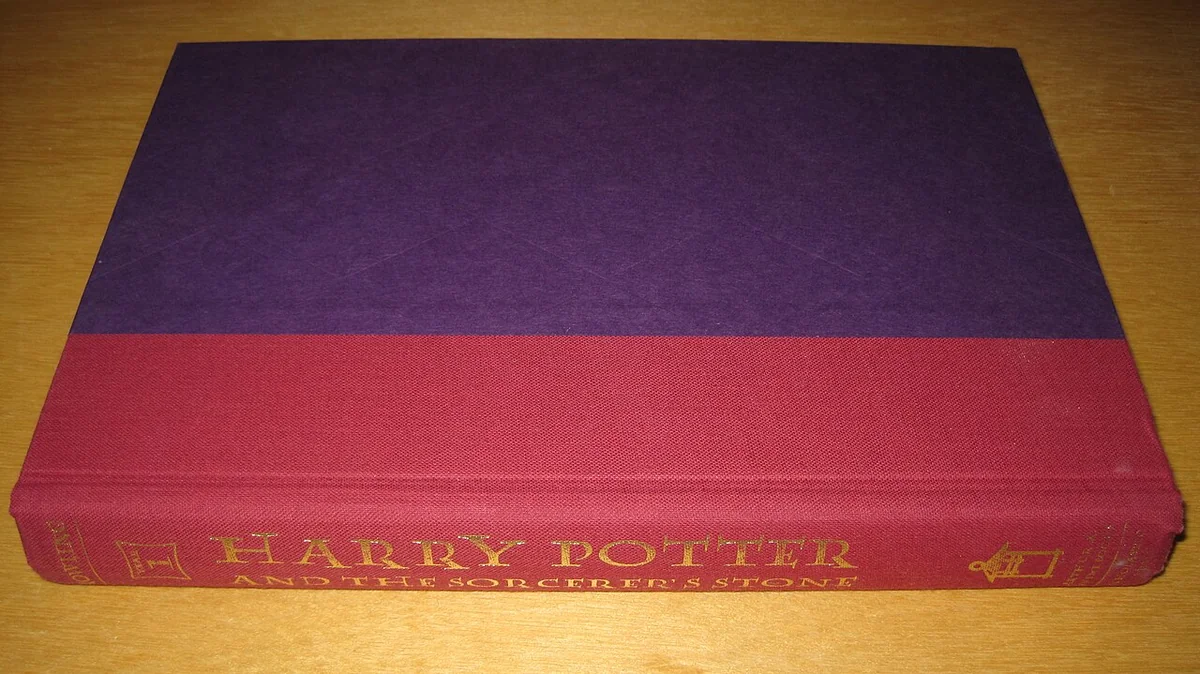

- Heritage Auctions, Dallas, 9 December 2021: a first edition, first printing hardback in exceptional condition sold for $471,000, reported at the time as a record for the book in any form (Fine Books Magazine and Antique Trader).
- Hansons, Staffordshire, 9 March 2022: a pristine first-printing hardback, bought for £12.99 years earlier, made a hammer price of £69,000 to an online bidder in the USA, above its £40,000 to £60,000 estimate (Chichester Observer and Scripps News).
Results like these are for the best copies. Ex-library first-printing hardbacks with stamps and wear sell for a fraction of those sums, and first-printing paperbacks sit lower again. For how we turn sales into ranges, see how much is my book worth.
Check your copy
Start with our Harry Potter collecting hub, which lists every Bloomsbury first hardback and first paperback with its printings and issue points. The money pages are the 1997 hardback and the 1997 paperback of Philosopher's Stone, and the Prisoner of Azkaban hardback with its two states. Everything by the author is on the J. K. Rowling page, and unfamiliar terms are in the glossary.
Frequently asked questions
How do I know if my Harry Potter book is a first edition?
Open the copyright page. A Bloomsbury first printing of the first three books shows a number line that runs all the way down to 1 and only one date, the year of publication. From Goblet of Fire onwards, look for the words First Edition on the copyright page and check that the ISBN matches the standard children's edition.
Does '1 wand' on page 53 mean my Philosopher's Stone is a first edition?
No. The repeated '1 wand' appears in the first printing but also in some later printings, so it supports a first but never proves one. The number line ending in 1 on the copyright page is the deciding check.
How many first edition Philosopher's Stones were printed?
Bloomsbury printed 500 hardbacks, about 300 of which went to libraries, and 5,150 paperbacks in June 1997. Both formats count as the first edition and neither has priority.
Is a US Scholastic Sorcerer's Stone a first edition?
Only of the American edition. The first American edition says First American edition, October 1998 on the copyright page, but it came after the 1997 Bloomsbury book, had a much larger print run and is worth far less.
Are the later Harry Potter first editions valuable?
Usually not very. Goblet of Fire, Order of the Phoenix, Half-Blood Prince and Deathly Hallows had enormous first printings, so an ordinary first edition sells for modest sums and value rests on fine condition, a clean jacket or a verified signature.
Is an ex-library Philosopher's Stone still valuable?
Yes. Most of the 500 first-printing hardbacks went to libraries, so stamps, labels and sleeve marks are normal on this printing. A genuine ex-library first impression is still worth thousands of pounds, though less than a clean copy.
Where these facts come from
- A Guide to Identifying Harry Potter First Editions, Sotheby's, 2026 (sothebys.com)
- The Very First Appearance of Harry Potter, Sotheby's (sothebys.com)
- Harry Potter First Edition Sells for $471,000, Sets Modern Literature World Record, Fine Books Magazine, 2021 (finebooksmagazine.com)
- Harry Potter and the Philosopher's Stone Sells for $471,000, Antique Trader, 2021 (antiquetrader.com)
- Pristine first edition bought for £12.99 sold at auction for £69,000, Chichester Observer, 2022 (chichester.co.uk)
- First edition Harry Potter book found in bargain bin sells for $69,000, Scripps News, 2022 (scrippsnews.com)
- J.K. Rowling, Harry Potter and the Philosopher's Stone, first edition, first printing, Heritage Auctions lot 36354 (historical.ha.com)
- Harry Potter and the Philosopher's Stone, Jonkers Rare Books (jonkers.co.uk)
Points of issue are listed only where at least two independent sources agree. Last reviewed 17 October 2026.
Last reviewed 17 October 2026.