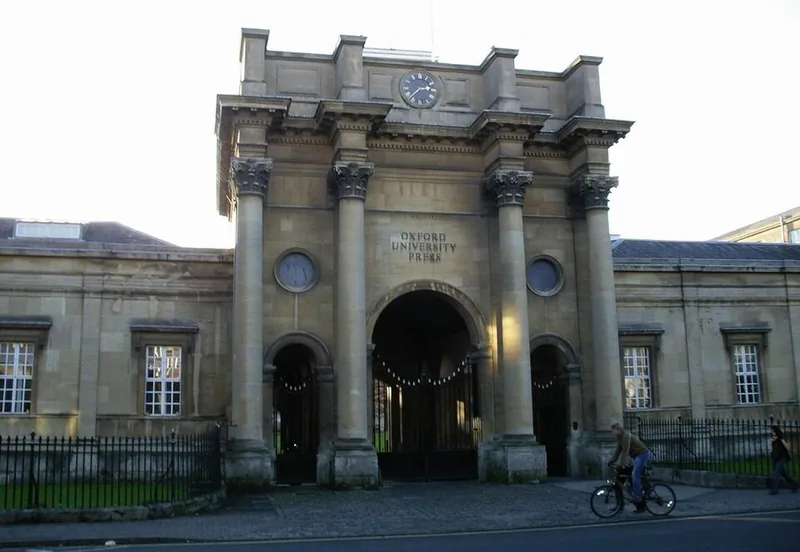
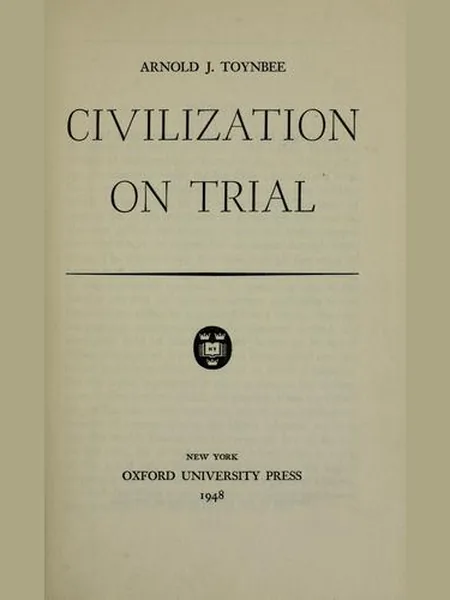
Oxford University Press is the University of Oxford's publishing department, printing under formal right since 1586; for most of the 20th century its firsts carry no edition statement, only an absent reprint record.
Oxford University Press is a publisher based in Oxford, founded in 1586. We track 512 editions it published between 1861 and 2022, 299 of them first editions across 450 books. How Oxford University Press marked its first editions is set out below, with a checker for the year on your title page.
About Oxford University Press
Oxford University Press (OUP) is the publishing house of the University of Oxford, a department of the university whose formal right to print dates from 1586, and the publisher of the Oxford English Dictionary.
The first book printed in Oxford appeared in 1478. A decree of 1586 confirmed the university's right to print, and Archbishop William Laud's Great Charter of 1636 allowed it to print "all manner of books". Printing moved into the Clarendon Building in 1713, the origin of the Clarendon Press imprint. Lewis Carroll paid the press to print the first edition of Alice's Adventures in Wonderland (1865). The press took on the dictionary in 1879; it began appearing in 1884 and the first edition was completed in 1928.
OUP opened its first office abroad, in New York, in 1896, and under Humphrey Milford (1913 to 1945) the press greatly expanded its overseas trade.
For collectors OUP also matters for literature and children's books. Its first editions include C. S. Lewis's The Abolition of Man (1943), Rosemary Sutcliff's The Eagle of the Ninth (1954) and Philippa Pearce's Carnegie Medal winner Tom's Midnight Garden (1958).
OUP is governed by academic Delegates of the Press appointed by the vice-chancellor and remains wholly owned by the university.
Holding a copy? The first edition checker shows Oxford University Press's practice for the year on your title page.
Identification
How to identify Oxford University Press first editions
What to look for
OUP did not say "First edition" on its books for most of the twentieth century. You identify a first by the absence of any record of later printings, not by a positive statement. Clarendon Press is OUP's own imprint, named after its Oxford building, so a Clarendon Press book is still an OUP publication.
Before 1980
There is no first edition statement. Later printings are recorded on the copyright page, so a copy whose copyright page shows only the original date, with no reprint or new edition listed, points to a first printing.
1980s
From 1990
On a book with a number line, the lowest number present gives the printing; a line that includes 1 marks a first printing.
Book club copies are often smaller than the trade edition and their jackets usually carry no price.
How do I identify an Oxford University Press first edition?
OUP did not say "First edition" on its books for most of the twentieth century. You identify a first by the absence of any record of later printings, not by a positive statement. Clarendon Press is OUP's own imprint, named after its Oxford building, so a Clarendon Press book is still an OUP publication. Before 1980 - There is no first edition statement. Later printings are recorded on the copyrigh
How many Oxford University Press books does MyVolumes track?
We track 512 editions published by Oxford University Press, 299 of them first editions, across 450 books.
Sources
Where these facts come from
First edition identification by publisher, ILAB (ilab.org)