Harper & Row was the New York publisher formed in 1962 from Harper & Brothers (founded 1817). It first published Where the Wild Things Are and became HarperCollins in 1990.
Harper & Row is a publisher based in New York City, founded in 1817. We track 410 editions it published between 1928 and 2021, 290 of them first editions across 396 books. How Harper & Row marked its first editions is set out below, with a checker for the year on your title page.
About Harper & Row
Harper & Row was the New York publishing house created in 1962, when Harper & Brothers merged with Row, Peterson & Company. In 1990 it was joined with the British firm William Collins, Sons to form HarperCollins.
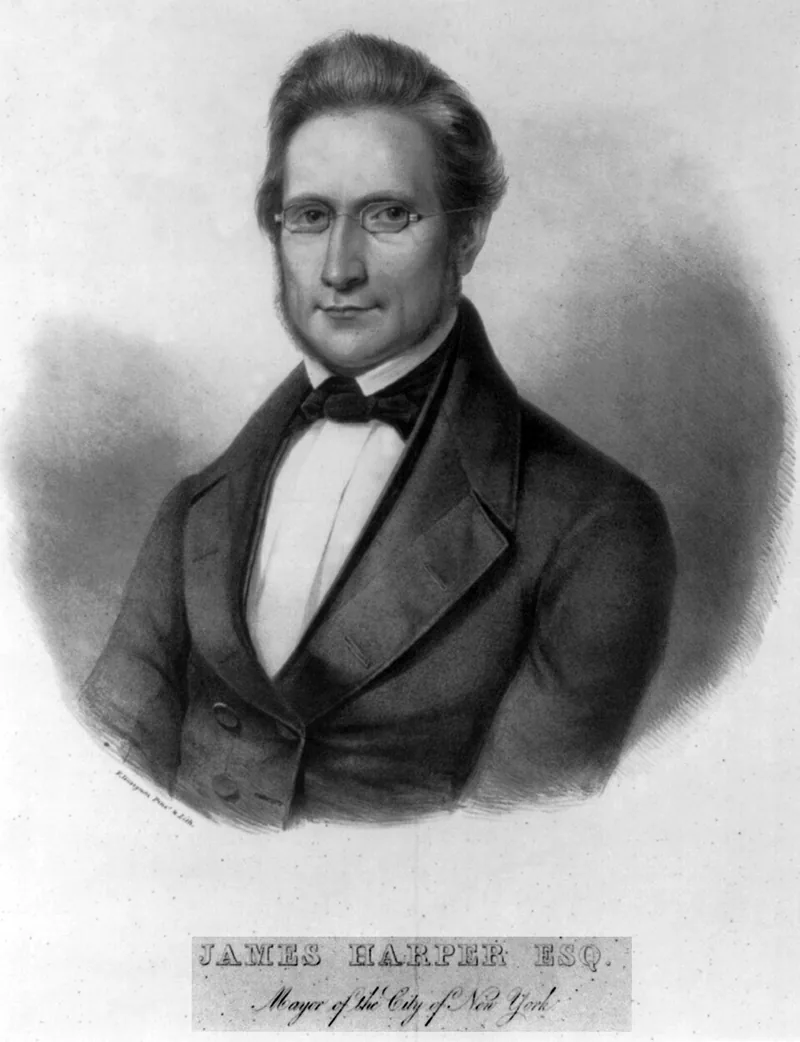
The business began in New York in 1817 as J. & J. Harper, set up by the printer brothers James and John Harper, who were later joined by two younger brothers. It became Harper & Brothers in 1833, started Harper's New Monthly Magazine in 1850 and added Harper's Weekly in 1857.
Under the Harper & Row name the house kept a strong children's list. It first published Maurice Sendak's Where the Wild Things Are (13 November 1963) and Shel Silverstein's The Giving Tree (7 October 1964). Its religious list moved to San Francisco in 1977, and in 1980 Thomas Y. Crowell and the trade side of J. B. Lippincott were folded into the firm.
News Corporation bought Harper & Row in 1987, and the house acquired the religious publisher Zondervan in 1988. Since 2007 the main imprint has been called simply Harper, so collectors meet one continuous house under three names: Harper & Brothers, Harper & Row and HarperCollins.
Holding a copy? The first edition checker shows Harper & Row's practice for the year on your title page.
Identification
How to identify Harper & Row first editions
British practice
Before 1912
Harper & Brothers did not state first editions. A first printing should carry the same year on the title page and the copyright page, with no note of other printings.
1910s to 1950s
From 1912 a short code of two letters appears on the copyright page: the first letter gives the month of printing and the second the year.
The month letters run A (January) to M (December), skipping J, so K is October, L November and M December.
From about 1922 a first printing also states "First Edition" on the copyright page next to the code.
1960s
After the 1962 merger Harper & Row carried on with "First Edition" on the copyright page together with the letter code.
In 1969 the house switched to a row of printing numbers at the foot of the last printed page, usually in the gutter before the rear endpaper, while keeping "First Edition" on the copyright page.
1970s to 1980s
A first printing has "First Edition" on the copyright page and a number row that still includes 1. If the lowest number is higher than 1, the copy is a later printing.
A jacket with no printed price is most often a book club edition.
Book club copies are often smaller than the trade edition and made with cheaper paper.
Look for a small blind stamp (a dot or simple shape) pressed into the back board near the foot; Book-of-the-Month Club copies commonly have one.
From 1990
From 1990 the house traded as HarperCollins, so a book dated 1990 or later with the Harper & Row name deserves a closer look.
US first editions
Harper & Row was formed in 1962 when Harper & Brothers merged with Row, Peterson, and became HarperCollins in 1990.
It inherited the Harper & Brothers practice of printing "First Edition" on the copyright page of a first printing.
From 1912 Harper & Brothers also printed two code letters on the copyright page for the month and year of printing: months run A (January) to M (December) skipping J, and years start at M for 1912 and run through the alphabet, again skipping J.
Where a number row appears on the copyright page, the lowest figure is the printing, whatever order the figures run in (1 2 3 4 5, 1 3 5 4 2 or 5 4 3 2 1), so a row that still includes 1 normally means a first printing.
Book-of-the-Month Club copies are usually the same size and quality as the trade edition, so size is no guide. Look instead for a jacket with no price on the front flap and a small blind stamp (a dot, circle or square) low on the rear board. BOMC printed prices on some jackets in the 1970s, but those copies still carry the blind stamp.
A rear-board mark is not always a club sign: a few very large printings were shared between printing plants, each of which embossed its own mark.
Before 1912 - Harper & Brothers did not state first editions. A first printing should carry the same year on the title page and the copyright page, with no note of other printings. 1910s to 1950s - From 1912 a short code of two letters appears on the copyright page: the first letter gives the month of printing and the second the year. - The month letters run A (January) to M (December), skipping J
How many Harper & Row books does MyVolumes track?
We track 410 editions published by Harper & Row, 290 of them first editions, across 396 books.